Hey everybody! Tara's out of town this week so she's getting her minions to do guest blog posts. I'm Daniel, art director at Third Degree. I'm kind of the nerdy one in the creative department, so this is going to be a bit longer than Tara's usual posts. It's good stuff though!
Trolling your Social Media Campaign 
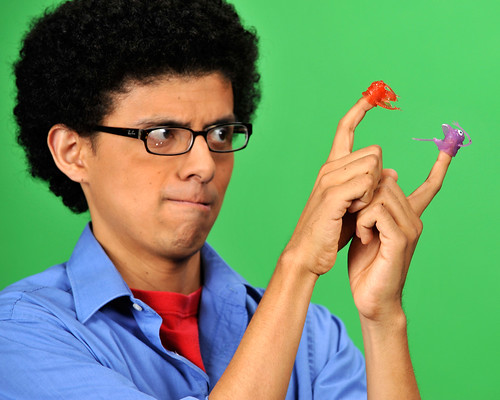
You’re playing in your sandbox, building up this awesome castle with your friends. You spent lots of time and energy making a community for your toy cowboys and dinosaurs and robots to hang out together peacefully and productively.
Then some bully stomps all over the Pleasantville you worked so hard to cultivate.
You just got trolled.
When you open your social media campaign to public commentary and contribution by your community, you also run the risk of people abusing that generosity. These are “trolls,” and you gotta know how to deal with them.
Who are trolls?
There is always a risk on open-mic night that someone will use their stage time to shout profanities at the audience. You now have to make a decision:
Do you kick them off stage?
Do you respond at all?
Do you cut the mic for everyone?
It’s a tough call, but the first step is knowing who you’re dealing with. A troll is anyone who baits a community with disruptive and offensive content thereby causing people to become upset or to be insulted. In
The Subtle Art of Trolling, the activity is explained with a bit of anarchist glee:
“The well-constructed troll is a post that induces lots of newbies and flamers to make themselves look even more clueless than they already do, while subtly conveying to the more savvy and experienced that it is in fact a deliberate troll.
“If you don't fall for the joke, you get to be in on it.”
It’s easy to dismiss a troll as a bully run amok in the world’s biggest playground, but it’s not so clear-cut when you have to be the judge. What you might consider a troll may be an honest critique or disappointment with your service, for example. You have to get at the heart of what drives someone to troll.
Is everyone a potential troll?
If you ask some trolls why they do it, they’ll say “For the lulz.” In other words, “because it’s funny,” or “because we can.”
But it’s never so clear-cut as all that. Philip Zimbardo, professor emeritus at Stanford, constructed a psychological experiment in 1971. He created a prison simulation in the basement of the Stanford psych building and randomly assigned college students to be prisoners and guards. The students soon fell into their roles far more sincerely then had been predicted, with emotional trauma and sadistic tendencies soon developing in all the participants.
Zimbardo would go on to write about the experiment in his book “The Lucifer Effect.” As it turns out when most people are given anonymity and are not held accountable for their actions, they’ll pretty much turn into jerks.
These findings are further supported in 1991 research by Professor Mauri Collins’ “Flaming: The Relationship Between Social Context Cues and Uninhibited Verbal Behavior in Computer-mediated Communication.” In that paper, she proposes
“In the absence of social context cues, the level of uninhibited verbal behavior in computer-mediated communication rises…”
This is a couple years before the world wide web even gets mentioned in mainstream media, but trolls are still a problem. She goes on to site a paper by N.S. Baron:
“Baron postulates three explanations for this phenomenon: the lack of non-linguistic and visual cues puts added pressure upon the users to use any means possible (such as haranguing) to ensure they are being understood; the fact that [Computer-Mediated Communication] is a relatively new form of communication and lacks the established norms of face-to-face conversation; and the lack social context cues masks status differences.”
That citation is from a paper in 1984. Eighty-four! So, with the internet offering even more anonymity and less accountability than any other media, it’s no surprise that the occasional bad egg might stink up your community.
How to deal with a troll?
The nice thing about trolls being around since the days of breakdancing is that we have a lot more experience to draw from when dealing with this kind of behavior. Wikipedia probably has to deal with this problem more than any other online community, so let’s see what they use as best practices for their editors.
Don’t feed the troll. It’s what your mom always taught you to do when you had to deal with bullies. Just let whatever the troll says slide right on by, letting the natural flow of communication chart a course around the troll.
“While many seasoned veterans of online communities consider this advice useless, because in a community of any size, someone will react to the troll's posts, others still consider it to be the only effective method for dealing with trolls. Not fanning the fire will, at the very least, not make the situation worse. If the behavior escalates to abuse or vandalism, it is easy to deal with those things.”
Establish clear, public policies for how you deal with inappropriate content. Stick to those policies! Don’t make any special exceptions or act capriciously in your judgements. Anyone who joins a community should know there are level-headed, even-handed moderators standing by to quell abuse. This will also dissuade any potential trollish behavior on the part of community members.
“…[O]ne should keep every debate strictly factual. A heated deletion discussion, possibly fueled by inflammatory comments by the troll or his sockpuppets and allies, may increase the troll's motivation.”
Assume good faith. While you’re standing vigilant against trolls, you may end up squelching honest, genuine discussion of your services. If a comment or posting does not obviously break your terms of service in regards to profanity, vandalism or objectionable material, take a moment to consider your action. If you choose to engage with the suspected troll, ask him or her to rephrase their statements.
“Sometimes trolls live under bridges. But not everyone living under a bridge is a troll. […] Often one is accused of being a troll because one is phrasing one's views in a particularly hostile way. Consider: are you openly advocating trolling on your userpage? Are you cursing at people or engaging in personal attacks? Are you accusing those who oppose you of being in a cabal? If you stopped that, people would probably respond better to you.”
There is one additional suggestion not advocated by Wikipedia, but I’ll just toss it in:
Make everyone accountable by removing anonymity. As noted in the research by Philip Zimbardo, giving people anonymity and removing any accountability is just paving the way for flagrant, abusive behavior. Even superficial security measures like requesting full names, email addresses and recording IP addresses can help mitigate the potential to troll. Using login tools like OpenID or Facebook Connect can make your campaign easier to join and removes the temptation to troll.
Water (and trolls) under the bridge.
When you have open contribution from the general public, you open yourself up to the honest opinions of your audience. This can open up a fruitful, mutually beneficial line of communication between a service-provider and those who use that service.
Even if those comments and contributions don’t fall strictly in line with your brand message, don’t assume that those people are all trolls to be deleted and banned. Listen with an open mind and genuine interest.
When more malicious behaviors arise, deal with them fairly and consistently. Doing so will establish a common trust with your community and ensure your brand’s good standing in general opinion.
Citations
TED Talks: “Philip Zimbardo show show people become monsters… or heroes”
Wikimedia: “What is a Troll?: Dealing with Trolls”
ReadWriteWeb: “Are Trolls Ruining Social Media?”
Mauri Collins: “The Relationship Between Social Context Cues and Uninhibited Verbal Behavior in Computer-mediated Communication”
Michael Marshall: “New Scientist Technology Blog: “Don’t flame me, bro”

 Hey everybody! Tara's out of town this week so she's getting her minions to do guest blog posts. I'm Daniel, art director at Third Degree. I'm kind of the nerdy one in the creative department, so this is going to be a bit longer than Tara's usual posts. It's good stuff though!
 You’re playing in your sandbox, building up this awesome castle with your friends. You spent lots of time and energy making a community for your toy cowboys and dinosaurs and robots to hang out together peacefully and productively.
 There is always a risk on open-mic night that someone will use their stage time to shout profanities at the audience. You now have to make a decision:
 If you ask some trolls why they do it, they’ll say “For the lulz.” In other words, “because it’s funny,” or “because we can.”
 The nice thing about trolls being around since the days of breakdancing is that we have a lot more experience to draw from when dealing with this kind of behavior. Wikipedia probably has to deal with this problem more than any other online community, so let’s see what they use as best practices for their editors.
 When you have open contribution from the general public, you open yourself up to the honest opinions of your audience. This can open up a fruitful, mutually beneficial line of communication between a service-provider and those who use that service.